Payroll Standard helps your whole organisation agree on how it pays people, so implementations run faster, compliance holds up and your payroll team isn’t buried in pay queries.
Payroll doesn’t decide how people are paid. It inherits decisions made across HR, workforce management, legal and industrial relations.
No two people read an industrial instrument the same way, and each reading can be technically correct.
Inconsistent interpretation means inconsistent pay. Long before that becomes an underpayment, it is already costing you: every disputed payslip is manually checked, every edge case is escalated and argued, and every answer is rebuilt from scratch by whoever happens to pick it up.
Teams carry extra headcount just to absorb the queries. And when the interpretation was wrong all along, the bill arrives as remediation, back pay and enforcement action.
Payroll Standard breaks every Award and Enterprise Agreement into obligations and entitlements, maps them to the floor of legislation, and layers your organisation’s own custom and practice over the top.
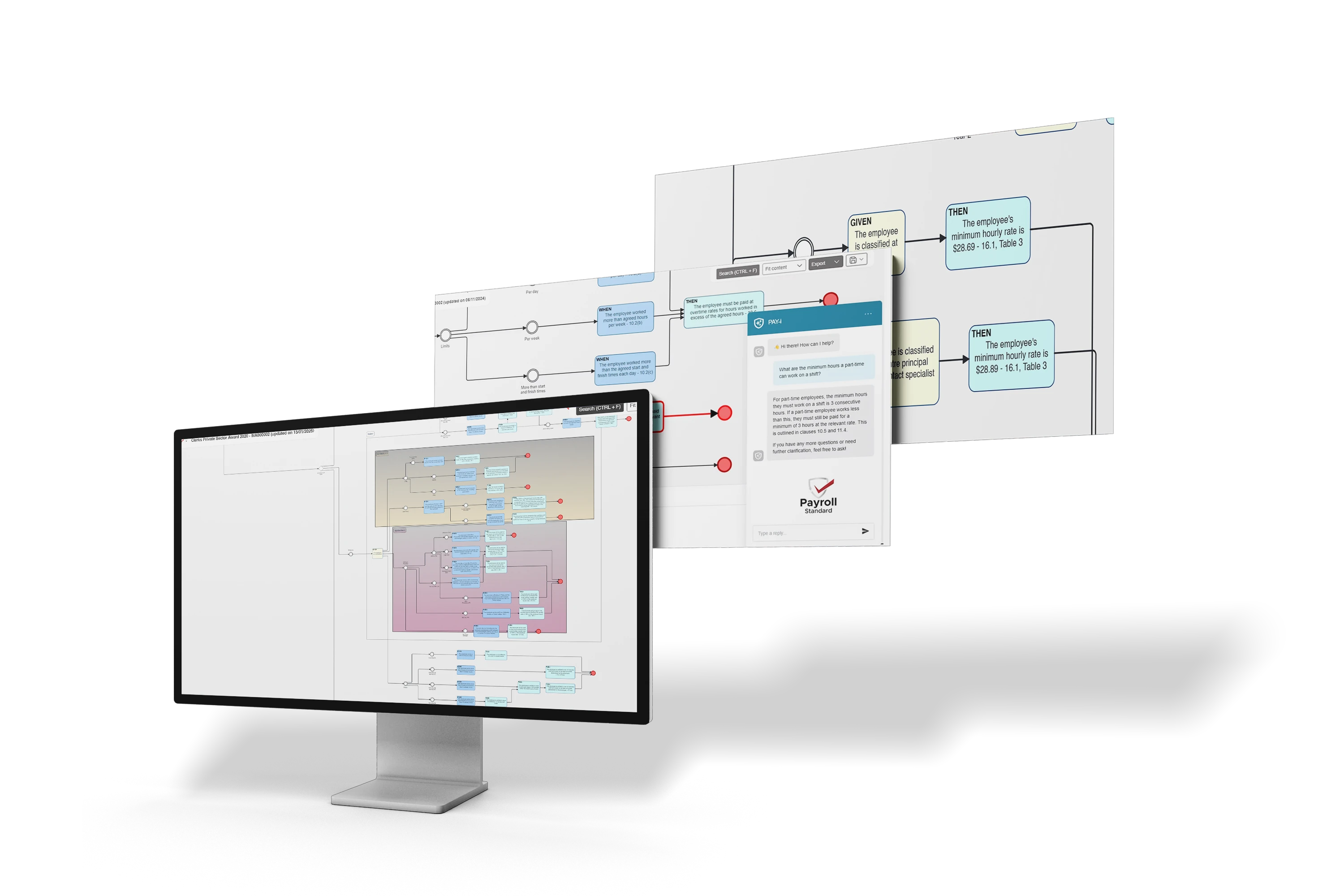
Each part reads from the same agreed interpretation, so the map, the answers, the config, the tests and the remediation can never tell you different things.
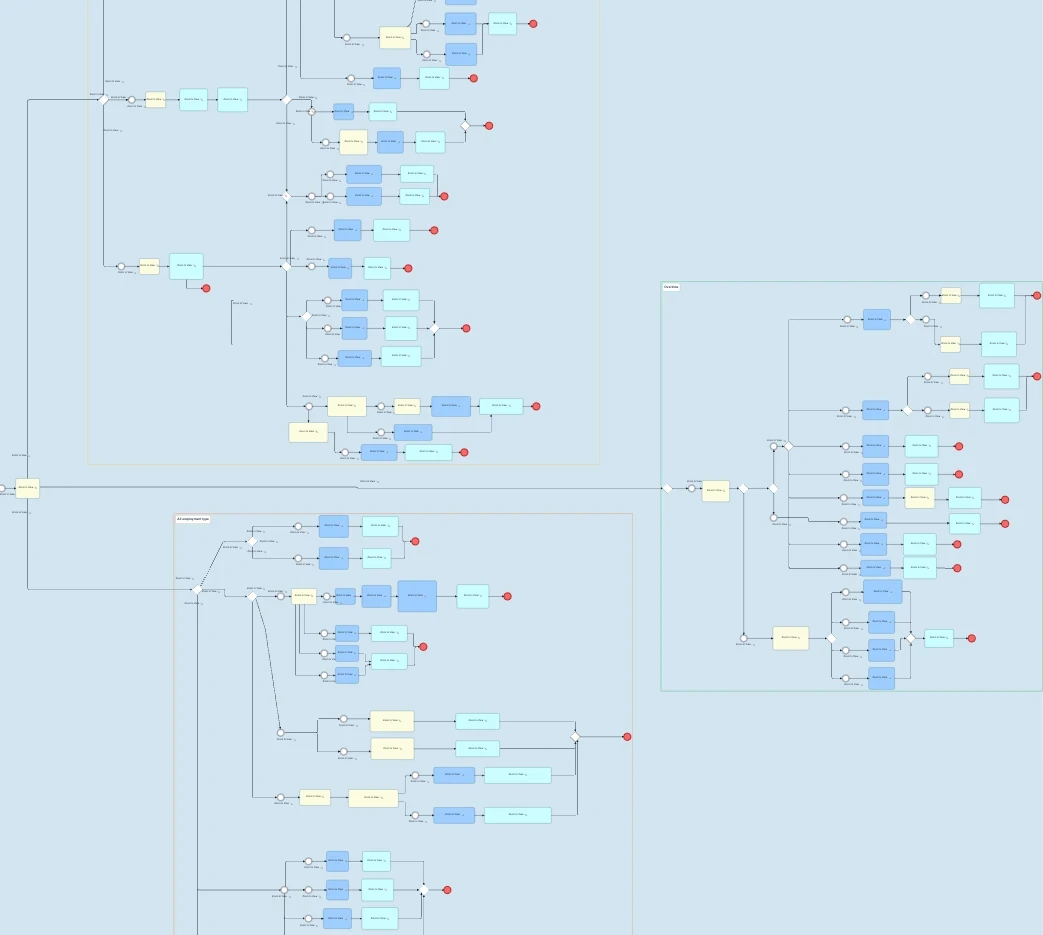
A Payflow is your Award or Enterprise Agreement rebuilt as a visual map. HR, IR, legal, payroll and executives all work from the same agreed interpretation, with one definitive answer to any pay question.
Each instrument is mapped on its own canvas, and you can map as many entities, agreements and pieces of legislation as your organisation runs on. Complex obligations become something you can see, follow and audit, rather than something one person holds in their head.
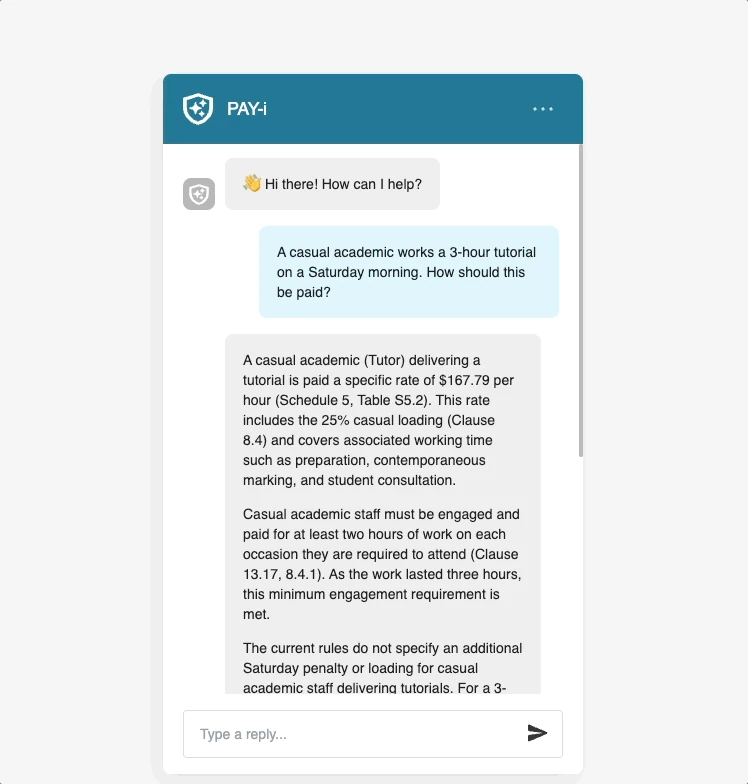
PAY-i gives your workforce and payroll team immediate answers based on your approved interpretation, not generic AI.
Every response points to the exact clause behind it and highlights the path it followed through your Payflow, so anyone can check the working. If PAY-i is not confident, it says so instead of making something up.
Available on web, iOS and Android, so people self-serve instead of picking up the phone to payroll. Pair it with PAY-BoK, our knowledge centre covering Long Service Leave, superannuation, the National Employment Standards and Award interpretation.
One organisation was fielding 3,000 pay queries a fortnight, costing 350 hours of payroll time. PAY-i cut that by 90%.
PAY-Config generates implementation-ready configuration workbooks directly from your Payflow, ready for Dayforce, Workday, SAP or UKG. What takes weeks of manual configuration takes seconds.
Every configuration item traces back to the Award, Enterprise Agreement or legislative obligation it came from, so every decision is transparent and auditable. And because the business agreed the interpretation before a line of config was built, you are not discovering problems in UAT, when they are most costly and time consuming to fix.
Test cases come straight from your Payflow, so every rule your business has agreed is covered, whether you are running one test or one thousand.
End-to-end, UAT and parallel pay run testing pull your best people out of BAU for weeks, and the budget to cover them has to come from somewhere. PAY-Test generates the test cases, runs them against your built config and validates your parallel pay run. Where you would plan six weeks for testing, you may only need two.
Already mid-migration and worried? Run a BOOT Test to compare your configured system against your approved pay rules, find the gaps and get a defensible path to go-live.
PAY-Check recalculates your actual payroll against your Payflow rules to find and quantify underpayments and overpayments, so payroll remediation is defensible and audit-ready.
PAY-Test proves a payroll system is configured to your rules. PAY-Check verifies what people were actually paid against those same rules, employee by employee, and puts a number on every gap. The result is a remediation figure you can stand behind: traced to the clause, consistent across the workforce, and ready for an auditor or a regulator to inspect.
A short look at an Award becoming a Payflow, and what your team does with it once it is there.
Trends and analytics on what your people are asking, confidence in your risk profile, and the auditable evidence the board wants.
One place where interpretation, policy, compliance boundaries and negotiation clarity all line up.
Self-serve answers to “what’s this on my payslip?” on an app, instead of a phone call to payroll. Transparency builds trust.
Out of the helpdesk and back to value-add work, with their reputation protected because the rules are the business’s, not theirs.
For most organisations, paying people is the single largest cost, and in most organisations nobody owns the rules that govern it. HR sets policy. Legal and IR negotiate and advise. Line managers make the calls on the ground. Workforce management sits in the middle, owned by no one in particular. Payroll is at the end of the chain, transacting on decisions it did not make and carrying the risk when they turn out to be wrong.
Managing interpretation deliberately closes that gap, and the value lands well beyond payroll. Policy matches practice, because both are written from the same source. ER and IR can cost a proposed EA change before agreeing to it, instead of discovering the cost in the first pay run after it. Legal has defensible boundaries in writing. Leadership gets sight of a risk it currently cannot see, and evidence it can put in front of a board.
Long Service Leave has no national rule. It is different in every state, with averaging rules and stacking rules on top. And if your payroll or workforce management system is new, it does not have the history to average across five years.
So nine times out of ten it sits as an unmanaged risk, propped up by manual workarounds. Payroll Standard captures and manages those rules, turning one of the most common sources of payroll risk into something you can see and audit.
Since January 2025, intentional underpayment is a criminal offence under Fair Work.
Compliance failures can put everyone on the line, from payroll managers to the C-suite, with serious breaches carrying potential jail time.
Boards and CFOs now need auditable evidence, not assurances. Payroll Standard gives you that evidence.
It is what lets your leadership team go to bed knowing their people are looked after, and that they can prove it.

Ready to see Payroll Standard in action?
Request a Demo
Not quite. Payroll systems calculate pay. System integrators build the solution. Payroll Standard defines the rules. SIs deliver to a fixed structure, and vendors can’t always match your exact interpretation, so people and process quietly fill the gap. Usually nobody notices until it’s a problem. We’re for the client: we sell direct, and we work alongside your payroll system, your SI and your vendors to make that gap visible before it bites. There’s no need to replace anything you already run.
No, and we would not build it that way. Awards are open to interpretation, and interpretation is subjective, so we never let AI do it. Your business documents and locks down its own interpretation first, in plain English. PAY-i can only answer from inside that, it can’t go looking on the internet, and when it isn’t sure it says so.
Because legislation never stops moving. End of financial year, Award updates, tax tables, Payday Super. Your subscription keeps your Payflows current, PAY-i accurate and your people across every change. It works the same way as every other system you rely on.
Modern Awards are already built and verified, so you start from a map rather than a blank page. Building a modern Award takes about three days and an Enterprise Agreement about five. Your version is a Child Payflow of ours, so you keep the maintained base and layer your own custom and practice on top.
That’s exactly when a BOOT Test earns its keep. We compare your configured system against your approved interpretation, surface the gaps and give you a defensible path to go-live.
A Payflow is a documentation language built by Payroll Standard that represents an Award or Enterprise Agreement interpretation in plain, unambiguous language. It is tailored to how your business actually pays people, so everyone reads the same rules the same way.
Yes. Ask something like “I’m a full-time Level 2.1 shiftworker, 3pm to 2am Tuesday to Sunday with a 30-minute unpaid break, how should I be paid?” and PAY-i returns the pay lines, penalty and overtime triggers, and the reasoning behind each.
Payroll Standard monitors Fair Work, the National Employment Standards, and each State and Territory Long Service Leave Act. When the law changes, the authoritative interpretation is updated and pushed to you, so you stay compliant without manual research.
Every action is logged: who edited, saved, or accepted a change and when. Profiles keep versioned snapshots and exportable audit reports, giving you demonstrable evidence for auditors, enterprise bargaining, and dispute resolution.
The platform is hosted in Australian cloud infrastructure for data sovereignty, with encryption, access controls, and regular security audits.
Or email us at sales@payrollstandard.org.